A broadcast transaction is not the same as a credited balance. A transaction hash tells an investigator where to start on the blockchain but cannot independently prove that an external account balance was credited. Separate hash, chain status, required confirmations and application credit.
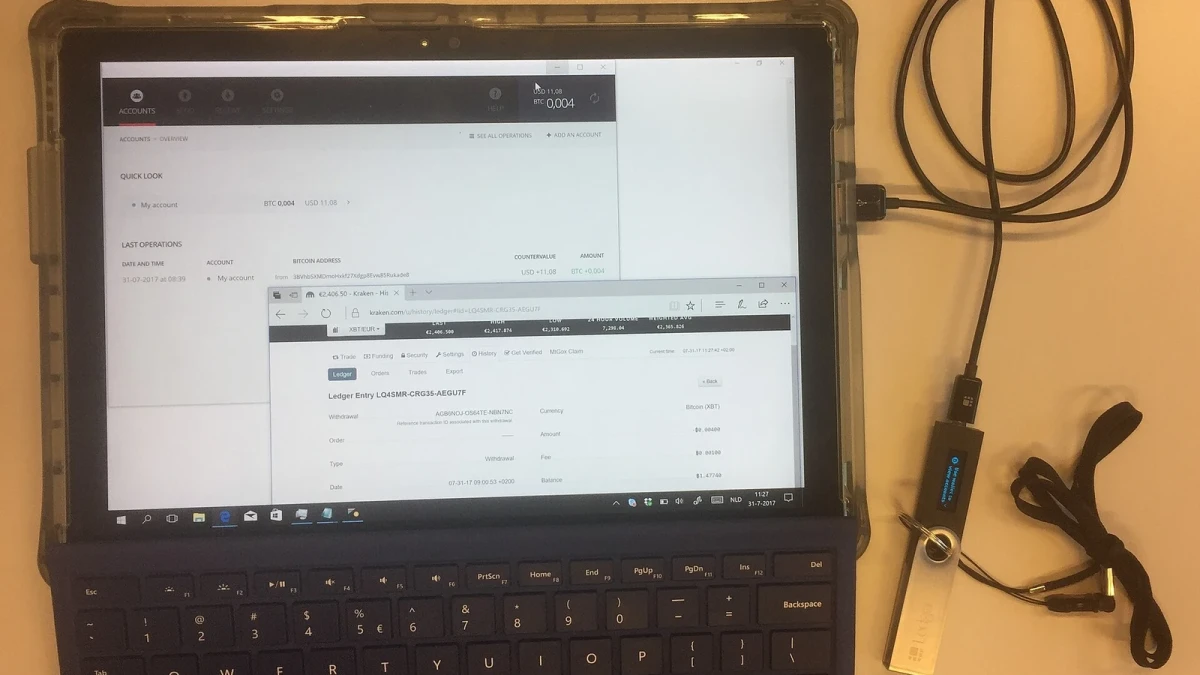
A photographed laptop and hardware wallet illustrate a recorded blockchain transaction.
The network confirms but the account waits
A wallet reports that a USDT transfer has been sent and provides a transaction hash. The receiving account has not yet credited the amount. These observations can both be accurate. A hash means the network can be queried about a transaction; it does not prove that a separate business system has posted the payment into a customer's available balance.
Different meanings of a transaction status
There are several distinct stages: submission to a network, inclusion in a block, additional confirmations, monitoring by a receiving service and final application credit. Different services can set different confirmation thresholds. An explorer describes what happened on-chain, while an account ledger describes how the recipient processed it. Comparing these layers makes a support case far more precise than saying the money simply disappeared.
Reading a blockchain result without overclaiming
Imagine a wallet displaying a green confirmation and a transaction hash while the expected account still has no credit. It is tempting to treat the hash as proof that the account operator has failed, but the hash identifies an on-chain event, not the private record of every recipient system. The first investigation is technical: which chain, token contract, destination, amount and transaction status does an independent explorer show? Only after that can the user ask whether the recipient's processor and ledger have recognized the same transfer.
A blockchain transaction may be broadcast, included in a block and followed by additional confirmations. The gap between an on-chain confirmation and actual account credit is also central to what instant crypto deposit claims leave out. Those events can take place before the recipient's internal deposit monitor accepts the payment. For token transfers, inspect the asset transfer details as well as the overall transaction status. A successful contract interaction is not always identical to the expected token movement. Record the block time and token amount, then compare them with the receiving service's stated confirmation threshold, minimum credit and deposit-address instructions. If a memo or account reference was required, its absence is another plausible explanation for missing internal credit.
The support message should avoid phrases such as 'the money vanished'. A stronger report states that the chain shows a specific transfer to the expected address at a specific time and that the destination account has not posted the corresponding balance. Include the hash, exact chain, amount, destination and internal account reference. Never share seed phrases or private keys as proof. The chain and application can each report their own state truthfully; the unresolved task is connecting the two records.
How to read a USDT hash correctly
- Use a known explorer for the selected chain and find the exact hash. Check status, token contract where relevant, amount and destination.
- Confirm the wallet actually broadcast a transaction. A locally generated request or pending signature is not an on-chain confirmation.
- Compare network confirmations with any threshold published by the receiving service, without assuming the threshold is identical across providers.
- If chain settlement is complete but credit is absent, open support with the hash, chain, receiving address, amount and the destination account reference.
Why a green wallet icon can mislead
A block explorer can show a successful contract interaction that does not correspond to the token transfer a user expected. Read token events and the receiving address rather than relying solely on a green status banner. Avoid giving a stranger wallet credentials or seed phrases in response to a supposed reconciliation issue.
A hash is not an internal account receipt
A transaction can have several valid statuses at once: confirmed on-chain, pending in a processor and absent from a merchant ledger. Naming the layer makes diagnosis substantially clearer.
Locate the last verified settlement stage
A transaction hash is an evidence key, not a universal receipt for account credit. The diagnosis should specify where the process stopped. This distinction is especially useful for crypto deposits to betting platforms, where processors and account ledgers may add their own steps.
For more on assessing betting deposits and withdrawals before committing funds, consult https://4xbetnet.com/. Why Withdrawal Rules Matter More Than a Long Deposit Menu.
#USDTSafety #ConfirmationsTransaction #Verification